


Hello,
Welcome to Edition 4 of The Friday Reading List — your fortnightly antidote to the noise. Every two weeks, I share my favourite literature across crypto, finance, technology, culture, and beyond. I also share what I’m watching and reading, because life shouldn’t be all about price charts and portfolio bags.
Three editions in, and the format is starting to feel less like an experiment and more like a habit. With each edition, the reading list is getting longer, and I’m finally resisting the urge to include every single thing I read. Progress, phew!
Speaking of progress, I managed to curate something fun for y’all! Solve the puzzle and write back to us with the answer, and a lucky winner will get a shoutout in the next edition.
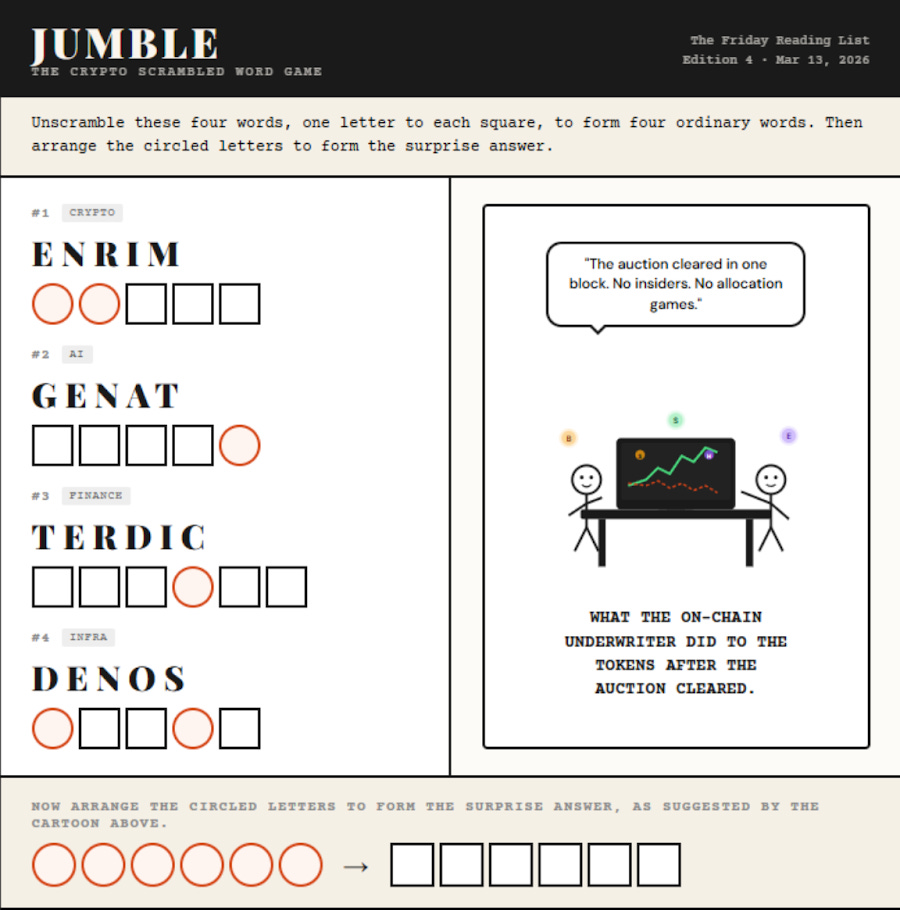
Didn’t get the answer? Wait for us to reveal them in our next edition.
Now, for the past fortnight. Let’s start with what moved and what didn’t.
The Fortnight That Was
Let’s get the elephant out of the room first. The last two weeks were dominated by one story, and it wasn’t crypto.
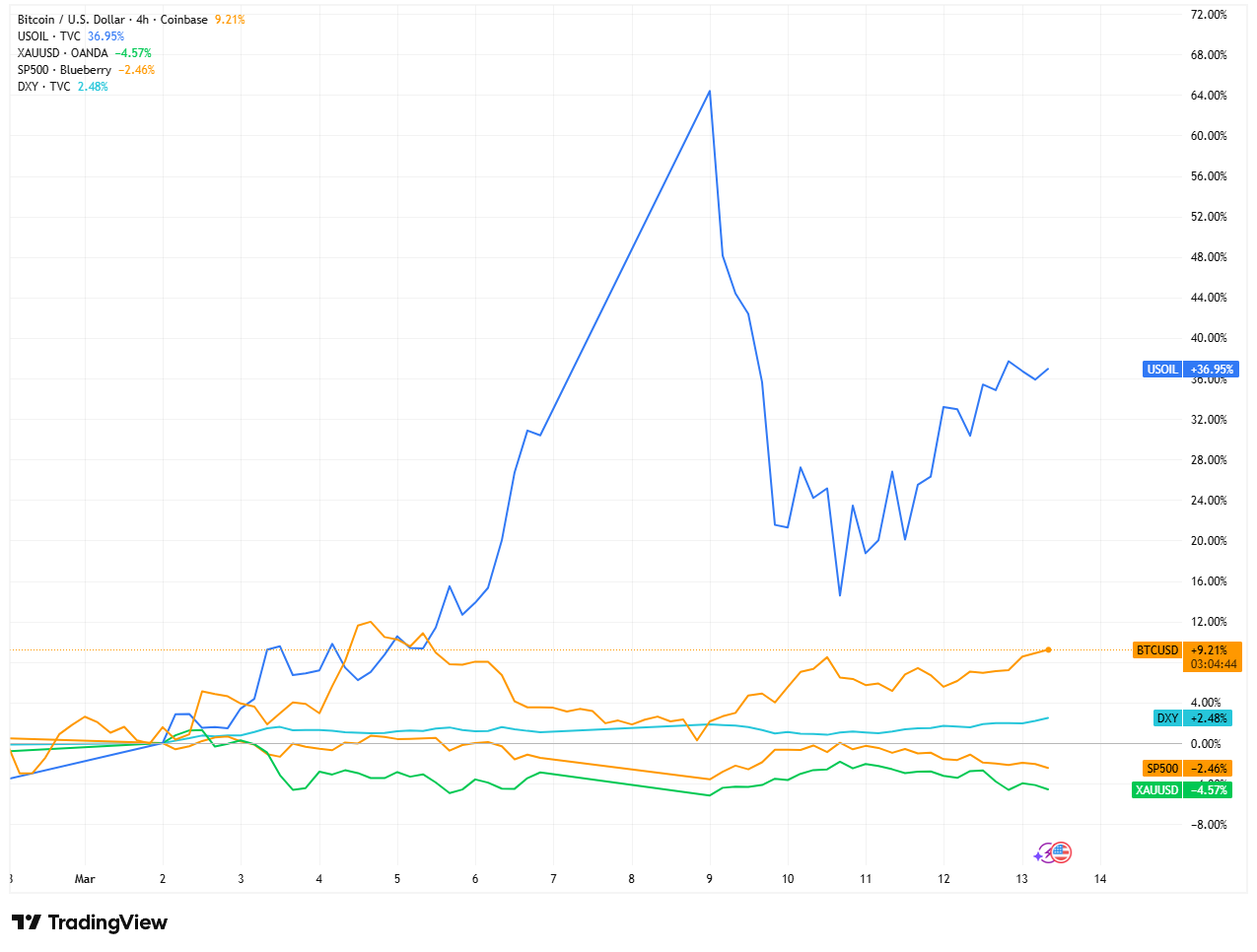
The U.S. and Israel launched strikes on Iran on February 28, and the Strait of Hormuz, through which roughly a fifth of the world’s oil and LNG shipments pass, was all but shut down. Oil did what oil does when supply arteries get squeezed: it panicked. USOIL spiked over 65% in a week before pulling back to around +37% by the time this edition goes out. Your timeline was likely flooded with memes about natural gas rationing, oil tanker rerouting, and people suddenly becoming armchair experts on Persian Gulf chokepoints.
The ripple effects were predictable yet painful. There’s no respite in sight as the world is gripped by uncertainty over the duration and extent of the war. Equities dropped in the past two weeks, with the S&P 500 down about 2.6%. Gold, which you’d expect to rally on war risk, instead fell 5%, while the dollar strengthened about 2.5%.
And then there’s Bitcoin. BTC climbed about 9% through all of this. Whether that’s a safe-haven signal or just crypto being decorrelated for once, I’ll leave for you to interpret.
Meanwhile, our bunch at Token Dispatch told stories about things that will probably stay relevant for longer than price movements and charts.
I started the fortnight by asking whether crypto can fix capital formation in Underwriting as Software. The piece traces the underwriting function from Edward Lloyd’s coffeehouse in 1688 to Hyperliquid’s HIP-6 proposal, arguing that whoever controls where a token is born captures the most durable fees in the ecosystem. A year ago, pump.fun-Raydium war was the proof; HIP-6 might be the next iteration.
Vaidik followed with Know Your Agent, a deep dive into the infrastructure gap between what AI agents can do and what they’re allowed to do. Automated traffic now exceeds human traffic on the web, yet confidence in autonomous agents has halved in the past year. The piece maps out the discovery, identity, and reputation layers that need to exist before an agent-driven economy can function at scale.
TJ explored what might become crypto’s most consequential distribution story in The Second Attempt. Meta is putting stablecoins into WhatsApp, Facebook, and Instagram, and this time, nobody is stopping them. The piece explains why the 2026 version is structurally different from Libra, why Stripe is the frontrunner to power it, and what it means for the 4 billion people who already use Meta’s apps daily.
Nishil wrote DeFi’s Capital Aggregator, where he unpacks how the vault ecosystem has unbundled into three specialised layers — protocol, curator, and distribution — and why over $6 billion flowed into on-chain vaults last year. The story gives us a glimpse of what the future of finance could be. The Crypto.com example shows how a retail user earning 4.82% on stablecoins, unknowingly backed by a Wall Street CLO fund tokenised through Centrifuge and managed by Janus Henderson.
I closed the fortnight with “Can DeFi Fix Private Credit?“, tracing the parallels between John Law’s Mississippi Bubble and the redemption crises affecting Blackstone, BlackRock, and Blue Owl’s private credit funds. In that piece, I explored whether on-chain private credit can fix the transparency and double-pledging problems, and what flaws it imports from the tradFi world.
We have a lot more coming over the next two weeks. Before we get there, here’s some literature that will keep you in good company. Some of these could be behind a paywall. (Sorry!)
Regulation & Policy
CFTC Offers First Guidance on Prediction Market Manipulation: The CFTC issues its first major advisory asking prediction market exchanges to consult regulators on manipulation-prone contracts
Crypto & Tech
The infrastructure story in DeFi is maturing fast. Vaults are scaling, lending is consolidating, and the platforms that control issuance are capturing the most durable revenue. Here’s what’s worth your time.
The “Investible” Crypto Tokens: Ignas combs through 17,000 tokens and finds only 132 worth holding amid the bear market; two protocols generate 69% of all holder revenue.
DeFi Lending Markets: Rosetta’s deep intelligence report on $45.6B in tracked DeFi lending TVL, Morpho overtaking Aave on Base, and the quiet rise of tokenised Treasury collateral.
Prediction Markets Won’t Scale Without Trust: Santiago Roel Santos argues insider trading is the single biggest growth constraint on prediction markets.
State of Crypto Leverage — Q4 2025: Galaxy Research walks through how on-chain lending declined with market prices, while CeFi lenders held steady through a historic liquidation event.
Coinbase launches Token Manager: Liquifi rebrands as Coinbase Token Manager, offering end-to-end token lifecycle tooling. including cap tables, vesting, compliance, and Prime custody in one platform.
Tether Invests in Eight Sleep at $1.5B: USDT-issuer makes a strategic health-tech bet, backing the AI-powered sleep company with plans to integrate its QVAC edge architecture.
What’s Kalshi’s Revenue?: A forensic analysis of all 203 million Kalshi trades, explaining how prediction markets work and how much money is flowing through them.
Coming of Age: My colleagues at Decentralised.co trace crypto’s shift from speculative premia to fundamentals
The Future of B2B Payments: Finance teams are finally treating payment infrastructure as strategic, not operational, and stablecoins are ready to step up.
The Financial Infrastructure Layer: Aave’s CEO makes the case that DeFi has solved supply-side liquidity and the next evolution is fixing the demand side.
Bringing the World On-Chain: How HIP-3 turns Hyperliquid into the “everything exchange”: global, open, and 24/7 financial markets.
In the Stables: The Rise of Yield-Bearing Stablecoins: Messari maps the quietly surging category that could reshape how passive dollars sit on-chain (behind paywall).
DeFi Is Becoming a Duopoly: DefiLlama’s data shows almost all revenue in most DeFi verticals is now captured by just the top two players.
Why Circle Thinks the Next Phase of Crypto Will Be About Payments: Circle is betting its future not on USDC alone, but on becoming the full infrastructure layer for internet-native money.
The $100B Revenue No One in Crypto Is Competing For: Trailer fees paid by global asset managers could become a recurring, AUM-linked revenue stream for tokenised fund issuers on-chain.
Fixed Rates Will Take DeFi Beyond Crypto: Morpho’s Paul Frambot argues fixed-rate markets are the missing primitive that will scale onchain lending to institutional money.
Agentic Commerce Won’t Kill Cards: a16z’s Noah Levine argues stablecoins won’t displace Visa, but AI agents will expose a new gap in merchant acceptance infrastructure.
Finance & Economy
Strategy Credits Where They’re Due: Byron Gilliam borrows Ben Thompson’s “strategy credit” framework to examine cheap corporate signalling in crypto and beyond.
The Worst Acquisition in History, Again: Scott Galloway traces Warner Bros.’ cursed M&A history — seven sales, mergers, and breakups — and why Paramount Skydance buying WBD won’t end well.
Private Credit Gets Marked Down: Bloomberg’s take on what happens when private credit portfolios finally face real markdowns (behind paywall).
President Trump’s CONFLICT Playbook: Twelve months of geopolitical conflict analysis distilled into a clear investor playbook for what comes next in the market.
AI & Innovation
ChatGPT Uninstalls Surged 295% After DoD Deal, Sensor Tower data shows a sharp consumer backlash. ChatGPT uninstalls spiked while Claude downloads jumped 51% following Anthropic’s Pentagon refusal.
Top 100 Gen AI Consumer Apps: a16z’s March 2026 deep dive broadens its lens to include AI-augmented incumbents such as CapCut and Canva, reflecting how AI has gone from a feature to a foundation.
Why the ATM Didn’t Kill Bank Tellers: David Oks flips the classic economics parable, ‘ATMs didn’t kill tellers, but the iPhone did’, and the lesson is about paradigm replacement that AI is bringing.
This Might Be the Last Job You Have: An analysis of how AI apps crossed 1B weekly users, with ChatGPT commanding 900M, built from scratch with no distribution advantage.
The State of Consumer AI — Part 1, Usage: Lightspeed’s Anand Iyer explores what stays investable when AI devours everything, only the “too fringe” ideas that APIs can’t replace.
Labor Market Impacts of AI: Anthropic’s March 2026 research paper presents new empirical data on how AI is already reshaping labour markets.
Culture & Beyond
Restless by Design: A beautifully written neuroscience essay on why we can’t sit still anymore, how constant stimulation rewired our default mode network and made stillness feel aversive.
A Quirk of Geology Explains Iran’s Oil: Scientific American explains how the same continental collision that created the Middle East’s oil reserves also trapped it behind the Strait of Hormuz. Timely, to say the least.
What I Am Watching & Reading
This weekend, I plan to watch Boong, a Manipuri film that has been winning attention well beyond India’s North East. The film is an important one not just because it was the first Indian film to ever win a BAFTA Award, but also because of where it comes from. Manipur, a small state tucked in north eastern India, spent the past couple of years in the shadow of brutal communal violence, loss of life, displacement, and repeated internet shutdowns.

I have also just started reading Not Without My Daughter by Betty Mahmoody. I am only at the beginning, but it already has the kind of emotional pull that makes you uneasy in a nice way. There is a rawness to it from the first dozen pages that I have read, and a tingling anticipation of an ordinary family story that’s about to turn into a difficult and harrowing one.
Between the two, this weekend’s unwinding schedule looks full.
Write back to us with any recommendations through the next fortnight that you think we should include in the upcoming edition.👇🏾
That’s all for this fortnight. Catch you in the next edition.
Until then, happy reading!
Prathik

Token Dispatch is a daily crypto newsletter handpicked and crafted with love by human bots. If you want to reach out to 200,000+ subscriber community of the Token Dispatch, you can explore the partnership opportunities with us 🙌
📩 Fill out this form to submit your details and book a meeting with us directly.
Disclaimer: This newsletter contains analysis and opinions of the author. Content is for informational purposes only, not financial advice. Trading crypto involves substantial risk - your capital is at risk. Do your own research.