


Welcome to Edition 7 of The Friday Saturday Reading List — your fortnightly antidote to the noise. My editor felt the curated list would land better on a Saturday, instead of a Friday. So here we are! I hope you spot this in your inbox on a relatively free Saturday morning that lets you sit back and read some of these picks.
Every two weeks, I share my favourite literature across crypto, finance, technology, culture, and beyond. I also share what I’m watching and reading.
Hello,
The past fortnight felt like the market briefly exhaled amid all the war and macro uncertainties. I know the war is still far from over. The ceasefire is fragile, and a durable solution still feels far away. But markets seemed tired of moving with each announcement about war.
For now, the markets are pricing in what the next move would be.
The Fortnight That Was
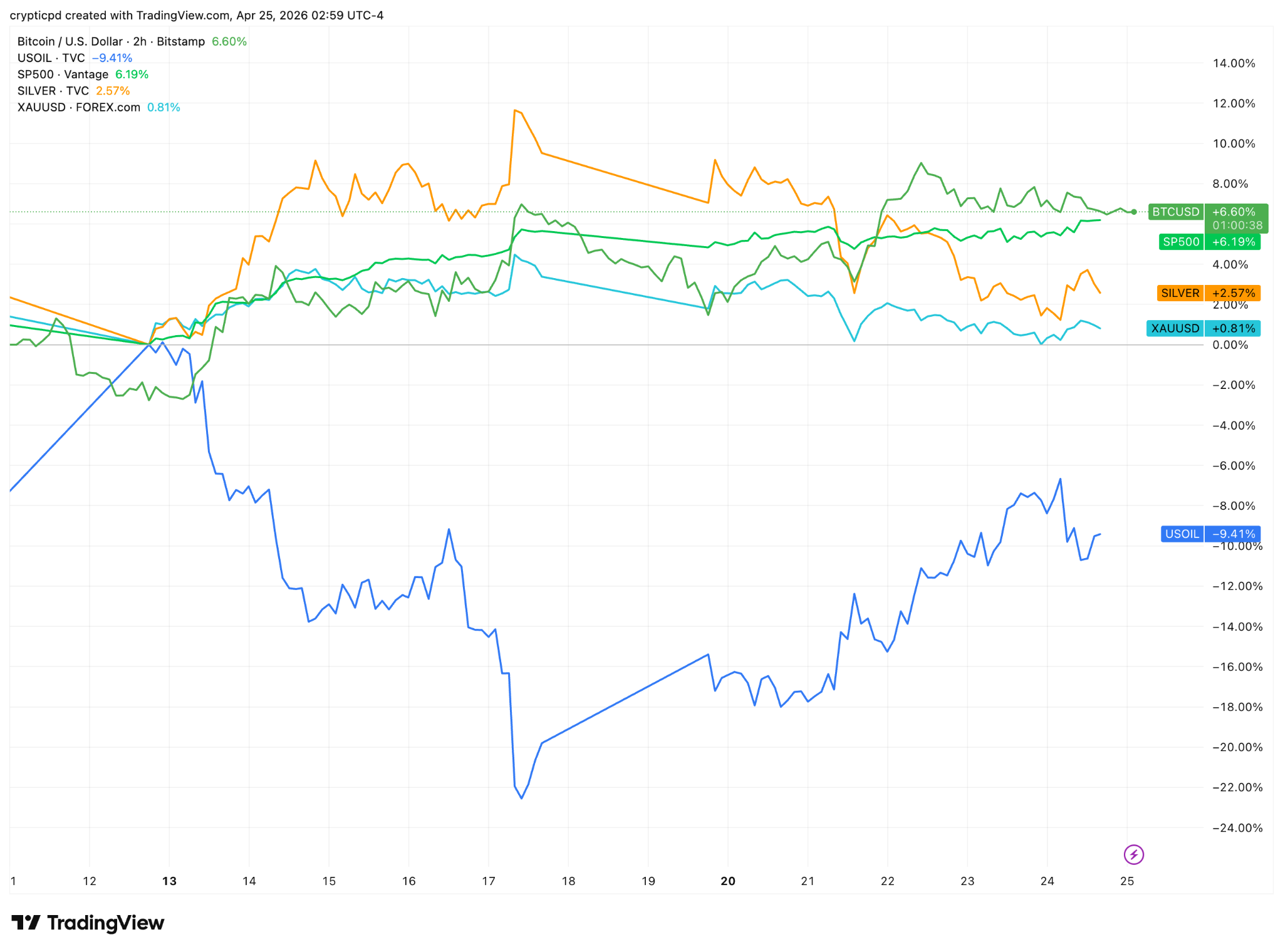
Risk assets, including equities and BTC, recovered well in the last two weeks, while oil has given back a chunk of its war premium even as the Strait of Hormuz remains far from fully operational.
Bitcoin rose about 6.6% through the fortnight, while the S&P 500 gained 6.2%.
Oil moved the other way. USOIL fell about 9.4%. That is probably the clearest sign that traders saw less immediate risk of a wider supply shock, even if the Strait of Hormuz question has not disappeared.
Despite multiple hacks and exploits in the last fortnight, builders in crypto infrastructure kept building and deploying. Both incumbent prediction market giants, Polymarket and Kalshi, announced the launch of perpetual futures trading.
Our team at Token Dispatch has written extensively on some of these topics.
I started with Ethena in When the Yield Runs Out, where I examined how USDe’s once crypto-native yield machine is now leaning into equities, commodities, institutional lending, prime brokerage, and RWAs to survive across more than one market regime. Ethena’s new strategy is diversification, but the old liquidity mismatch problem has not disappeared.
In another piece, Capital Budgeting, But On-Chain, I explained how Aave’s $25 million capital allocation vote shows DeFi moving beyond into a territory where it enabled token holders take capital budgeting decisions.
Thejaswini followed with The Fed Chair’s Portfolio, where she broke down the disclosed exposure of incoming U.S. Fed Governor candidate Kevin Warsh to Solana, Optimism, and many other crypto infrastructure companies.
She then wrote The Quantum Race is a Governance Test, in which she explains why quantum risk is not just a cryptography problem. She cites Bitcoin debates, Ethereum research, and how Tron can move fast because it is more centralised than it likes to admit.
Vaidik closed the fortnight with Why Google’s Billions Couldn’t Fix African Internet, a DePIN story that explains how Share is trying to fix the broken middle layer between African submarine cables and last-mile ISPs, using crypto.
You can see the theme running across the fortnight.
Even when the world outside crypto remains unstable, those within the ecosystem are busy building and deploying despite hacks, governance fights, and political conflicts.
Our team has lined up more stories around these themes for the coming fortnight. Until then, here’s a curated reading list to give you good company.
Regulation & Policy
The Tokenisation of Stocks: A useful map of the public, private, and in-between structures emerging as tokenised equities move from wrappers to market infrastructure.
What Can Be Tokenised?: Franklin Templeton’s broad reminder that tokenisation is not just stocks, but spans funds, bonds, commodities, private credit, real estate, and more.
A Guide to Crypto Crime: Amid ongoing hacks and exploits, Arkham has put together a taxonomy of crypto crime, from pig-butchering and drainers to mixers, bridges, ransomware, and laundering patterns.
Satoshi Coins Without a Freeze: Nic Carter argues for a cleaner Bitcoin quantum-transition path that deals with dormant Satoshi-era coins without resorting to a blunt freeze.
Crypto & Tech
Perps Are Coming to Polymarket: Polymarket’s next move pushes prediction markets closer to trading infrastructure, with leverage entering the product stack.
Kalshi Markets: Kalshi is turning sports prediction markets from betting-like products into trading venues.
Concentrated Liquidity for Lending: A DeFi lending idea that borrows from concentrated liquidity design to make lending markets more capital-efficient.
Airwallex Enters In-Store Payments: A payments-stack thread on why the next fintech challenge may be around building offline checkout, and not merely cross-border digital rails.
IR & Token Transparency in 2026: Novora benchmarks 150+ protocols and shows the gap between on-chain revenue visibility and actual investor-grade reporting.
Tokenised RWAs: $16 Trillion by 2030: Theo’s case for why today’s RWA market still looks tiny against the institutional asset classes tokenisation wants to absorb.
The Rise of Composable RWAs: Dune argues that what RWAs can be used as collateral, can be looped and composed inside DeFi, is more important than just tokenising all RWAs.
Beyond the Flywheel: Galaxy argues that DATs cannot survive as passive balance-sheet wrappers; they need staking, MEV, DeFi yield, or real operating models.
Finance & Economy
Uncharted Waters: Capriole reads Bitcoin’s macro, technical, and on-chain signals as quietly constructive despite AI-security fears and geopolitical volatility.
The Most Future-Proof Job: Shopify argues that entrepreneurship may be the safer hedge in the AI-era as business creation becomes cheaper and traditional jobs look shakier.
Break Now, Fix Later: Scott Galloway brings his wit to turning the White House ballroom fight into a broader critique of political destruction without credible rebuilding.
Apple’s Hardware Succession: Apple’s reported Cook-to-Ternus transition raises the question of whether hardware discipline can fix Apple’s AI-era drift.
AI & Innovation
The Future of Entertainment Is Interactive: Dylan Abruscato argues that entertainment will transcend its current passive viewing format to one in which audiences begin participating in the show itself.
The Agentic Economy Will Be Massive. Agentic Commerce Won’t: Dragonfly pushes back on the easy “agents need stablecoins” thesis by asking how many agents will actually need to transact.
Google’s $40B Anthropic Bet: Google deepens its Anthropic exposure, turning the AI race into an even more capital-intensive fight between cloud, compute, and model labs.
DeepSeek’s China Capital Moment: Tencent and Alibaba reportedly circling DeepSeek shows China’s AI champions are becoming national-scale strategic assets.
Mythos Accessed by Unauthorised Users: Bloomberg’s report on unauthorised access to Mythos is an example of why frontier AI security is now a market-structure issue.
5 Ways Blockchains Help AI Agents: a16z crypto lays out where blockchains can matter for agents: identity, payments, governance, trust, and user control.
Claude Design: Anthropic’s design product pushes Claude deeper into creative workflows, from prototypes and pitch decks to branded visual systems.
Culture & Beyond
The Art of Comparison: A thoughtful essay on personal finance that talks about comparing without letting envy, status games, or wealth ladders ruin your sense of progress.
The Mathematical Reason Most People Never Make It: A psychological essay on why outcomes are often nonlinear, delayed, and less forgiving than motivation culture suggests.
Does Reading Do Us Any Good?: Aeon makes the case for literature as a means of preserving attention, memory, and personal freedom.
How Darkness Might Save Migratory Birds: Scientific American explains how switching off artificial lights during migration windows can materially reduce bird deaths.
Justice Is Geometric: Aeon uses African fractal societies to show how bottom-up systems can encode reciprocity, circulation, and fairness without a single centre.
What I Am Watching & Reading
I had picked up Reporting from Ramallah last fortnight and made it through roughly a third of the book.
Amira Hass’ writing is sharp, humane, and observant. But I paused there because the book’s structure was hurting my reading rhythm. The chapters are short, almost like dispatches, and the context switches quickly from one piece to the next. Each article deserves attention, but reading them back-to-back made the experience feel slightly fragmented. It is the kind of book I think I’ll return to slowly, one or two pieces at a time, rather than race through in a week.
So, I moved to Scott Galloway’s Notes on Being a Man.
I’ve only just started, but it already reads like one that annoys, provokes, and occasionally makes the reader nod in agreement. Galloway starts with that familiar bluntness that I adore in his witty No Mercy/No Malice newsletter. More on the book in the next edition.
On the watching front, I’m planning to watch Hamnet this weekend.

I can’t wait to watch Oscar-winning Jessie Buckley play her character. Her versatility as an artist surprised me in The Bride!, even though the film itself was messy. There’s something about her screen presence that makes one want to keep watching how she carries her character even when the story around her is wobbling.
It’s going to be a packed weekend, but perhaps a good one.
Write back to us with any recommendations through the next fortnight that you think we should include in the upcoming edition.👇🏾
That’s all for this fortnight. Catch you in the next edition.
Until then, happy reading!
Prathik

Token Dispatch is a daily crypto newsletter handpicked and crafted with love by human bots. If you want to reach out to 170,000+ subscriber community of the Token Dispatch, you can explore the partnership opportunities with us 🙌
📩 Fill out this form to submit your details and book a meeting with us directly.
Disclaimer: This newsletter contains analysis and opinions of the author. Content is for informational purposes only, not financial advice. Trading crypto involves substantial risk - your capital is at risk. Do your own research.