


Hello
Welcome to Edition 11 of The Reading List — your fortnightly antidote to the noise. Every two weeks, I share my favourite reads across crypto, finance, technology, culture, and beyond. I also share what I’m watching and reading, because a newsletter that only talks about charts is a slow way to kill the will to live.

What I’m Watching and Reading
This edition, I am flipping the order of how we go about the editions because…why not?
I’m about three-quarters through Debt: The First 5,000 Years by David Graeber, which is a slow burn of a book, but a fascinating one. The book is a lot more about human relationships and behaviours that money grew out of: obligation, trust, who owes whom and why. It made me look at the thousands of years of social wiring underneath a simple transaction. I’ll have more thoughts once I close it out, but it’s already started reframing how I read the way money functions.
On screen, the last two weeks were a blast of human psychology from two very different angles. Obsession explored how far the pull of fixation can drag a person, and how little it takes to tip a strong want into something disastrous.
But what I didn’t prepare for was the ride that Backrooms took me on. Filmmaker Kane Parsons beautifully translates his strange internet idea of endless, fluorescent-lit liminal spaces into something genuinely unsettling on screen. The way the imagery conjures dread out of empty rooms and how deliberately it leaves you with more questions than answers are what stayed with me from the movie.

With Backrooms, Cannes-winning Renate Reinsve continues to have a blockbuster of a year. The movie adds another feather to the Norwegian actor’s award winning titles - The Sentimental Value and The Worst Person in The World. Chiwetel Ejiofor keeps you at the edge of your seat with the unreconciled conflicts his Captain Clark’s character carries within.
It’s a lovely watch for anybody who loves to leave the cinemas with a cloud of questions hanging over their heads and putting their minds to work in an uneasy manner (well, that’s just how weird my brain functions)
With that out of the way, let’s head to how the past fortnight fared.
The Fortnight That Was
Just days before we wrapped up the week, the U.S. and Iran signed a peace deal, committing to terminate operations on all fronts, including Lebanon. The 14-point agreement also states that Iran will never have a nuclear weapon and will also commit a $300-billion fund for the “reconstruction and economic development” of the country.
A deal, at last. Yet, Israel continued to attack Lebanon before the ink even dried. Over the last four months, we have seen this play out: a signed agreement here is never more than one missile away from being put on hold. That is just the volatile world we have been living in lately, with peace and outbreaks of violence sharing the same news cycle, sometimes within the same hour.
Markets still had something to cheer about over the past fortnight.
Bitcoin gained a modest +4.18% over the fortnight. Ether recorded ~9% gain, while the Nasdaq added 5%.
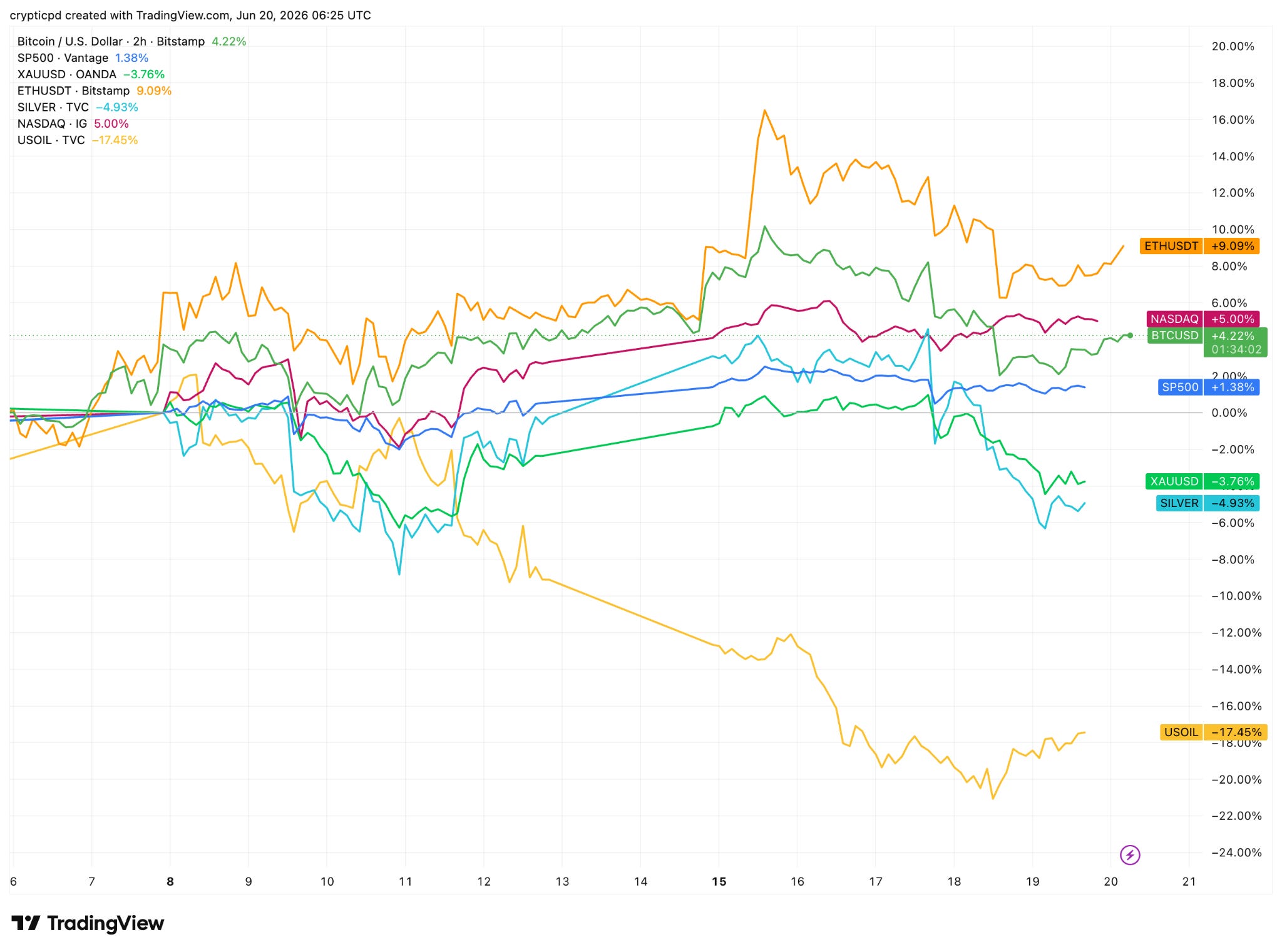
Yet nothing here suggests much about crypto’s future trajectory. Lately, we have been arguing at Token Dispatch that bitcoin’s chart and the crypto industry are decoupling for good. But don’t take our word for it. Look at the kind of stories we have been writing for the past two months and the stories I have been reading (some of which have been included in these reading lists for the past month). They prove the thesis of crypto’s evolution as fintech infrastructure far more convincingly.
What We Wrote at Token Dispatch
Throughout this fortnight, most of our stories addressed the one important question of who actually owns the value once the plumbing becomes invisible.
TJ closed it with Is Distribution Everything?, tracing how Coinbase, Stripe, and Kraken are owning the infrastructure they once rented. Through the piece, she also asks whether open-source protocols are destined to become the duct tape that fills the cracks the giants haven’t monetised yet. Vaidik picked up the same fight one layer up in The ‘Checkout’ War, dissecting why OpenAI’s Instant Checkout died six months in, and why the agentic-commerce land grab between Amazon, Google, and Stripe may be settled by stablecoin rails that make the middleman fight pointless.
I spent the fortnight on the IPO and the deposit. In The Unbundled IPO, I explained how SpaceX’s listing tore apart the banker’s old IPO bundle of pricing, distribution and delivery. I explored how banks’ roles will change in upcoming IPOs, with perp venues and prediction markets pricing in the stock weeks before the bell rings on the bourses.
Defending the Deposit followed the dollar itself, as stablecoins, tokenised deposits, and SoFi’s hybrid race to own convertibility. With Neobanks Have to Be Banks, TJ explained how the survivors of the neobank wave lived by getting a charter and lending you your own money.
All these stories collectively signal that crypto is growing into finance and integrating with traditional finance, rather than resisting it.
There’s more lined up for you in the coming weeks, but here’s a reading list to keep you company until then.
Regulation & Policy
Africa’s Stablecoin Moment: A look at how African stablecoin adoption is moving from proof of demand to the harder work of regulation, banking access, liquidity, and local-currency rails.
Crypto & Tech
The State of RWAs on Hyperliquid: Covalent maps how Hyperliquid’s HIP-3 has turned RWAs into 85+ always-on perp markets across stocks, indices, commodities, FX, and pre-IPO companies.
Vitalik’s Covered-Call Stablecoin: A take on Vitalik’s proposed stablecoin design, where stability comes from splitting ETH exposure rather than relying on liquidation-heavy debt.
Under the Uniswap Thesis: A useful pushback on the idea that tokenisation automatically benefits Uniswap, arguing that distribution, turnover, and value accrual matter more than headline RWA growth.
Crypto Enters the Space Age: Mert argues that crypto can no longer rely on patchable software standards; as AI improves formal verification, security and rigour become the industry’s next survival test.
Bitcoin Yield Is a Lie: A useful reminder that BTC has no native risk-free yield; every income strategy introduces counterparty, market, technical, or tail risk. (behind paywall)
Cost of Trust 2.0: 1kx updates its thesis around blockchains as trust-reduction infrastructure, with sharper focus on which trust markets can actually produce venture-scale outcomes.
The Race to Trade Everything: Galaxy breaks down Hyperliquid’s HIP-4 and how outcome markets could turn the perps venue into a direct competitor to Polymarket and Kalshi.
Rails Aren’t Enough: A sharp stablecoin payments piece arguing that enterprises do not just buy fast settlement; they need SLAs, exception handling, reconciliation, and payment operations that work when things break.
The Singleness of Onchain Money: Byron Gilliam uses 19th-century bank notes to explain why on-chain dollars need to become more fungible across issuers and venues.
Money Flow Is the Moat: A16z’s Jason Rosenthal argues that the best crypto businesses sit inside value flows, including payments, custody, credit, settlement, and not beside them.
The RWA Tokenisation Playbook: A beginner-friendly map of the RWA stack, from treasuries, credit, equities, and commodities to the issuers, curators, DeFi protocols, and apps that distribute them.
Finance & Economy
The Bitter Lesson as Moat: A quant-finance essay on why secrecy and know-how are weakening as moats, while compute-scaled systems, proprietary data exhaust, and distribution become harder to copy.
Ya Gotta Believe: Byron Gilliam uses the Knicks’ comeback and prediction-market pricing to show why investing is about probabilities, not certainties.
Bitcoin’s Institutional Ascent: ARK argues that ETFs, public-company treasuries, custody maturity, and retirement access are pushing bitcoin from speculative fringe asset to institutional allocation.
Robinhood’s Retail Finance Bet: Artemis makes the bull case for Robinhood as a Gen Z and millennial financial super-app, not just a crypto-correlated brokerage.
The Stock Market Gets More Stock: Matt Levine explains how AI capital demand, SpaceX’s IPO, and pre-IPO perps point to a new era where equity markets raise capital again instead of merely shrinking through buybacks.
Perps Don’t Work for Compute: Dave Friedman argues that compute needs dated forward curves, not perpetuals, because GPU-hours are perishable and hardware obsolescence is the real pricing problem.
The Art of Arbitrage: Yuan Han Li frames great crypto companies as arbitrage machines that find a gap, build a growth loop around it, and then graduate into durable mainstream businesses.
The Great Restructuring: Andrei Grachev argues that crypto is moving from belief-driven cycles to extraction and hard competition, where RWA and IPO perps make exchange listings even harder for new tokens.
AI & Innovation
AI Labs as L1s: Alok Vasudev compares OpenAI to Bitcoin and newer AI labs to alt-L1s, framing the AI lab race through crypto’s familiar hierarchy of incumbents and challengers.
The Untrainable: Sarah Guo argues that measurable AI work gets commoditised first, while messy organisational context, private correctness, and trust remain harder to automate.
Do Consumers Want Agentic Commerce?: A useful counterweight to agentic-commerce hype, asking whether consumer payment habits are actually ready for autonomous shopping.
A Frontier Without an Ecosystem: Satya Nadella frames the AI-era firm around human capital and token capital, where the real moat is the learning loop between people, workflows, data, and models.
Three Paths for Agentic Payments: A framework for agentic payments built around whether AI replaces, integrates with, or creates new payment behaviour.
Anthropic’s Safety Superpower: Ben Thompson argues that Anthropic’s safety mission, talent brand, data policy, and business incentives may be unusually aligned — and that this alignment is both powerful and worrying.
Owning vs Renting Intelligence: Lin Qiao uses the Mythos shutdown to argue that AI companies need to turn workflows, data, evals, and domain knowledge into owned intelligence rather than rented API dependency.
Who Prices Intelligence?: Jaya Gupta asks who will allocate and price intelligence when AI capability, cost, latency, and risk become independent product variables.
Workflows Are King: Jamin Ball argues that AI moats will move from systems of record to workflow orchestration, where the company coordinating the agents owns the strategic layer.
Culture & Beyond
Money Measures Life Poorly: A thoughtful essay on why money is the easiest scoreboard for life, but not the best one once time, health, relationships, and meaning enter the equation.
New Media Is Insider Media: Anu explains why small audiences of the right people can now matter more than mass reach, especially in Silicon Valley’s insider-media ecosystem.
What Is This Rock?: Aeon explores Anthropocene geology through strange human-made rocks, where industrial waste, tyres, coins, and natural processes blur the line between natural and unnatural.
Mostly Dead: Jords writes this personal essay on distraction, screen addiction, and the unsettling idea that time spent scrolling can feel like time spent outside the land of the living.
The Art of Presentmaxxing: Pascal turns mindfulness into a practical daily protocol, arguing that presence is built through small mundane “reps” rather than another optimised self-improvement ritual.
Want to recommend interesting literature? Write to me and I shall include them in the next edition 👇🏾
That’s all for this fortnight. Catch you in the next edition.
Until then, happy reading!
Prathik

Token Dispatch is a daily crypto newsletter handpicked and crafted with love by human bots. If you want to reach out to 170,000+ subscriber community of the Token Dispatch, you can explore the partnership opportunities with us 🙌
📩 Fill out this form to submit your details and book a meeting with us directly.
Disclaimer: This newsletter contains analysis and opinions of the author. Content is for informational purposes only, not financial advice. Trading crypto involves substantial risk - your capital is at risk. Do your own research.