


Hello,
Welcome to Edition 16 of The Reading List — your fortnightly antidote to the noise. Every two weeks, I share my favourite reads across crypto, finance, technology, culture, and beyond. I also share what I’m watching and reading.

I didn’t read much last fortnight. Instead I dusted off my own personal Substack and wrote about something that’s been on my mind for a while: the pleasure is in the process, but not outcomes. Perhaps give it a read?
This fortnight, I will get back to the book I am halfway through - When Genius Failed and give you a full review into what you could take away from it in the next edition.

Crypto Investing On Autopilot
You’ve probably had your brain fried tracking 50 things for the few tokens you handpicked from a pile of random. Crypto is not a joke. If anything, it is a sad place that robs people off their money. Glider builds on the opposite philosophy. It helps you pick a basket of assets and programmatically rotate it based on conditions you define.
One basket holds the Mag7 at equal weight.
Another mirrors congressional stock trades, the Pelosi Tracker.
Everything stays non-custodial. No gas fees either.
Today’s issue was sponsored by them, and it comes in the week they launched ATPs with Bitwise. More on their release on Bloomberg here. Explore how Glider combines RWAs and programmatic finance directly in its product here.

Let your strategy run itself at Glider.fi.
The Fortnight That Was
Last fortnight, the bond shook crypto from its deep slumber that lasted for months. Scott Bessent, the US Treasury Secretary, announced a plan to at least double the size of the Treasury’s quarterly bond buyback operations to lower borrowing costs and manage market liquidity.
This increases the maximum size of liquidity support buyback operations for longer-dated nominal coupon securities from $2 billion to at least $4 billion per operation.
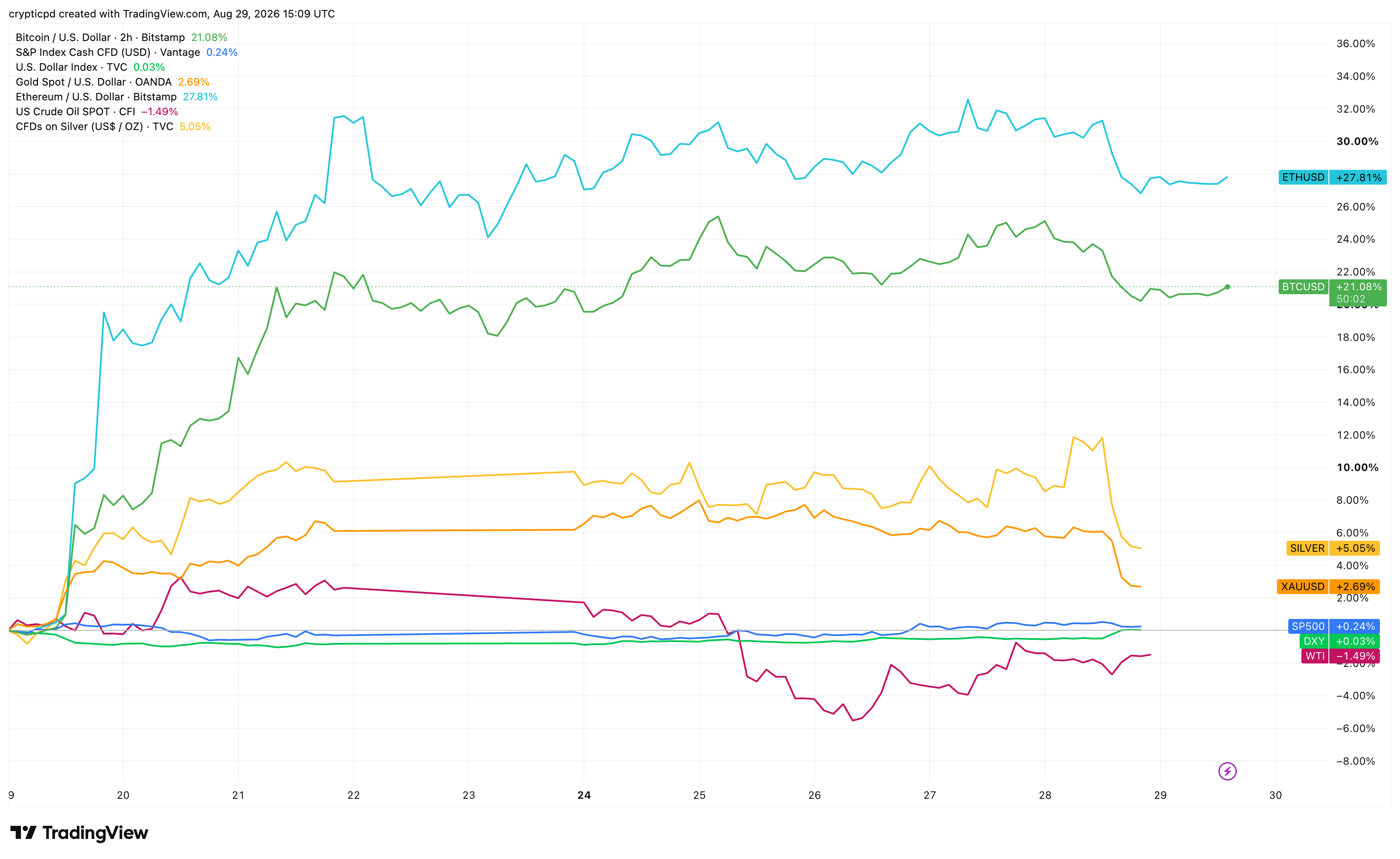
Crypto rallied in response to this. Long-end yields dipped, the dollar softened, and a market that had been leaning heavily short got run over. The market session on August 19 saw well over $1 billion in short liquidations.
Over the fortnight (Aug 16–29), Ethereum and Bitcoin shot up by almost a third and a fourth of their market caps. Everything else stayed flat.
Bitcoin remains well below both its January 2026 high and last October’s all-time peak. But for the first time in a while, the price moved in a direction that was different from sideways.
What We Wrote at The Token Dispatch
Last fortnight at The Token Dispatch, we focused a lot on what’s being built for an agentic, tokenised economy.
Vaidik opened with Agentic Payments With Fraud Check, where he examined OpenAI’s new receipt-verification cookbook that comes closest to a fraud check for autonomous agents transacting over x402. He also proved on whether an on-chain settlement record actually proves an agent bought the right thing, or merely that money moved.
TJ followed with Yield-Industrial Complex, on how Wall Street is now packaging every native crypto cash flow it can find, including BTCI’s 27% covered-call “yield,” Fidelity, Grayscale and 21Shares turning on staking in their ETFs, and stripping the income away from the underlying asset risk.
I wrote Unblocking Capital With Blockchains, on the $1.7 trillion trapped in excess working capital and the web of circular B2B debts that keeps it stuck. In this piece, I explored how blockchains can net those obligations the way Splitwise settles a group trip, or the way Wall Street solved its own paperwork crisis 60 years ago.
TJ then did a fancy experiment with AI agents in $5 Spent Well. In the field experiment, she handed an AI agent its own $5 wallet and watched it run Pixel Pet Studio, a do-or-die micro-business selling five-cent pixel animals and paying its own daily server rent - all this with no human in the loop.
Vaidik continued his series with Compute Capital Markets: Part IV. Here he traced where all the AI compute money actually comes from, including corporate cash flow, debt, equity, and now pension and insurance float. He also examined why the ~3-year lag between committing capital and getting working chips explains today’s shortage.
And I closed the fortnight with The Business of Trust, on how every era of commerce needs a new middleman to broker trust between strangers. In this piece, I explore how, in an age where agents spin up disposable identities in seconds, crypto rails (ERC-8004 identities, soulbound reputation tokens, behavioural scoring from the likes of Skyfire, RNWY and ChainAware) are racing to become the credit bureaus of the machine economy.
We are lining up a lot more interesting pieces for you in the coming weeks. Until then, here’s a recommendation list to give you good company.
Regulation & Policy
Banking lobby’s campaign against Clarity will backfire: Columbia’s Omid Malekan argues that banks holding the Clarity Act hostage over stablecoin yield are a hugely profitable industry demanding protection it doesn’t need and inviting populist retaliation.
The SEC sets crypto free: Byron Gilliam on the SEC’s proposed Safe Harbor rule, which gives protocols up to four years to reach a “decentralised or functioning” state and self-certify their exit from securities law.
Crypto & Tech
Tokenised Stocks Have Arrived. Their Credit Market Hasn’t: The piece maps a 24,000x gap between the ~$461B off-chain securities-backed lending market and the ~$19M of credit drawn against tokenised equities onchain, arguing the bottleneck is legal enforceability, not price or dividends.
Everything else is a name. Payments is a market: Alex unpacks H1 2026’s $11.2B crypto fundraising, showing the $2B “exchange” category is two mega-rounds and five licence-grab acquisitions rather than a broad venture signal.
Why commodity traders may be the strongest vertical for stablecoin banking: Kirill Bulychev argues stablecoin neobanks win many low-volume accounts but that commodity traders, with genuinely high transaction volumes, are the segment where the horizontal model actually pays.
A Second and Final Eulogy for Bitcoin Maximalism: Nic Carter argues Bitcoin succeeded wildly while nearly every testable maximalist prediction failed, using the Coldcard hack and the failed Filters coup as the ideology’s Great Disappointment.
Finance & Economy
The bond market has something to say again: Byron Gilliam on the Bond Vigilantes waking from a two-decade slumber as 30-year yields hit 20-year highs, with the Fed neutered by a $40T debt load and Congress unwilling to act.
Deep Dive: The Next Trillion-Dollar Futures Market: Chamath Palihapitiya on CME’s plan to launch compute futures, framing the financialisation of GPU-hours as AI capex ($765B) overtakes oil and gas for the first time.
AI Refi: Matt Levine explores the consumer-finance truth that lenders profit from customers who fail to optimise, and what happens to that edge when everyone has an AI to refinance their mortgage for them.
Predict the KPIs: Matt Levine on stocks as bets on future earnings and the strange market that emerges when the metric being predicted is itself a moving target.
AI & Innovation
Give me 20 minutes and I’ll make you impossible to manipulate: Dan Koe lays out three levels of thinking (NPC, Main Character, Programmer) and four daily habits — question, curate, read, create — to escape the “intellectual obesity” of the algorithmic feed.
The death of articulation: jords argues that outsourcing writing to LLMs risks a “genius on the tweets, illiterate on the streets” future, and that competent human communication is becoming a scarce, valuable edge.
What Does It Mean To Be Human, Now? Highlights and reading list from Cosmos founder Brendan McCord’s Aspen seminar, tracing an arc from AI’s “dethronement” of human function to what remains irreplaceable.
Human in the Loop: Nic Carter’s short story about a “responsibly aligned” future where mandatory human oversight turns every automated system into a bureaucratic farce — as a man’s ceiling slowly collapses.
The humanoid robot ‘Olympics’ is as ridiculous as it is impressive: Two robots beat Usain Bolt’s 100m record at Beijing’s World Humanoid Robot Games — then crashed into a wall (one caught fire), a neat illustration of narrow feats versus real-world competence.
Culture & Beyond
Twitter Brain: jords writes, as a self-described survivor, that the mind is shaped by what it consumes, and that a week of one-thing-at-a-time attention can rebuild a scattered attention span faster than you’d think.
Internet Overexposure Syndrome: Katherine Dee proposes that “Borderline,” “Autist,” and “Schizo” online archetypes are rational adaptations to the internet’s environment rather than the psychiatric conditions they resemble.
Empire of flight (Why birds don’t buy Bentleys): Antone Martinho-Truswell argues birds never developed complex culture because flight is an “evolutionary black hole” that removed the selection pressure that pushed humans toward it.
What’s this buzz about bees having culture? An Aeon/Nature video on Alice Bridges’ experiment showing untrained bumblebees learning a two-step puzzle by watching others — the first socially-learned problem-solving seen in an invertebrate population.
Where are all the aliens? A new book explores possible answers: Astrobiologist Seven Rasmussen on the Drake equation, the Fermi paradox, and the “cosmic mirror” idea that the technosignatures we hunt for reflect our own moment in technology.
Why your ability to cope with stress changes with time: Behavioural scientist Masha Remskar on how seasonal, circadian, and social rhythms stack to make resilience a dynamic balance rather than a fixed trait.
Some Thoughts on the Real World: Bill Watterson’s 1990 Kenyon commencement address on play, refusing to sell out, and inventing your own life’s meaning against a culture that measures worth by salary and title.
The Principles of Better Decisions: Hades argues better decisions come from better mental models and not more information. In this piece, Hades walks us through first-principles thinking and opportunity cost as tools for seeing what others miss.
Kulfi: Life After Swipe: Co-founder Garvit Agarwal on building Kulfi, a games app exclusively for couples that’s raced up India’s charts by owning the 9 pm-to-midnight bedtime slot, on a “content-as-engineering” playbook of 20+ in-house posts a day and zero paid marketing.
That’s all for this fortnight. Catch you in the next edition.
Until then, happy reading!
Prathik
P.S.: Want to recommend interesting literature? Write to me, and I shall include them in the next edition 👇🏾
Token Dispatch is a daily crypto newsletter handpicked and crafted with love by human bots. If you want to reach out to 165,000+ subscriber community of the Token Dispatch, you can explore the partnership opportunities with us 🙌
📩 Fill out this form to submit your details and book a meeting with us directly.
Disclaimer: This newsletter contains analysis and opinions of the author. Content is for informational purposes only, not financial advice. Trading crypto involves substantial risk - your capital is at risk. Do your own research.
Thanks for reading! Subscribe for free to receive new posts and support my work.