


Hello,
Welcome to Edition 21 of The Reading List. Every Saturday, I share my favourite reads across crypto, finance, technology, culture, and beyond, alongside what I’m watching and reading.
This week’s selection spends some time with the machinery behind the AI boom: the chips, the lenders, the inference businesses, and the people trying to steal its secrets to capture value.
First, a look at the week that was.
Let’s get going…


StablesReward: Your AI Agent Spends, You Earn
AI agents can surf the web, read reviews, and book hotels for you. All these tasks cost money. But what if these tasks could earn you back something?
StablesReward does just that. Once you connect your agent to an MCP endpoint, it gives your agent a menu of paid tools. Every call your agent pays for earns you miles or stocks. And this is in addition to the rewards you earn anyway on your own spending across 800+ merchants.

Every purchase pays you back. The best part is that you can choose how you’d like to be rewarded. Transfer miles to airlines and hotels, or let your stocks build a portfolio from the spend you were making anyway.
Launching soon. Free to join.
The Week That Was
Oil was the standout on our chart last week, gaining 7.83% while Bitcoin fell 1.88% and the S&P 500 CFD slipped 2.09%. Silver lost 6.29%, gold eased 0.51%, and the dollar index fell 0.49%. Expensive energy and weaker risk appetite made for an uncomfortable combination.
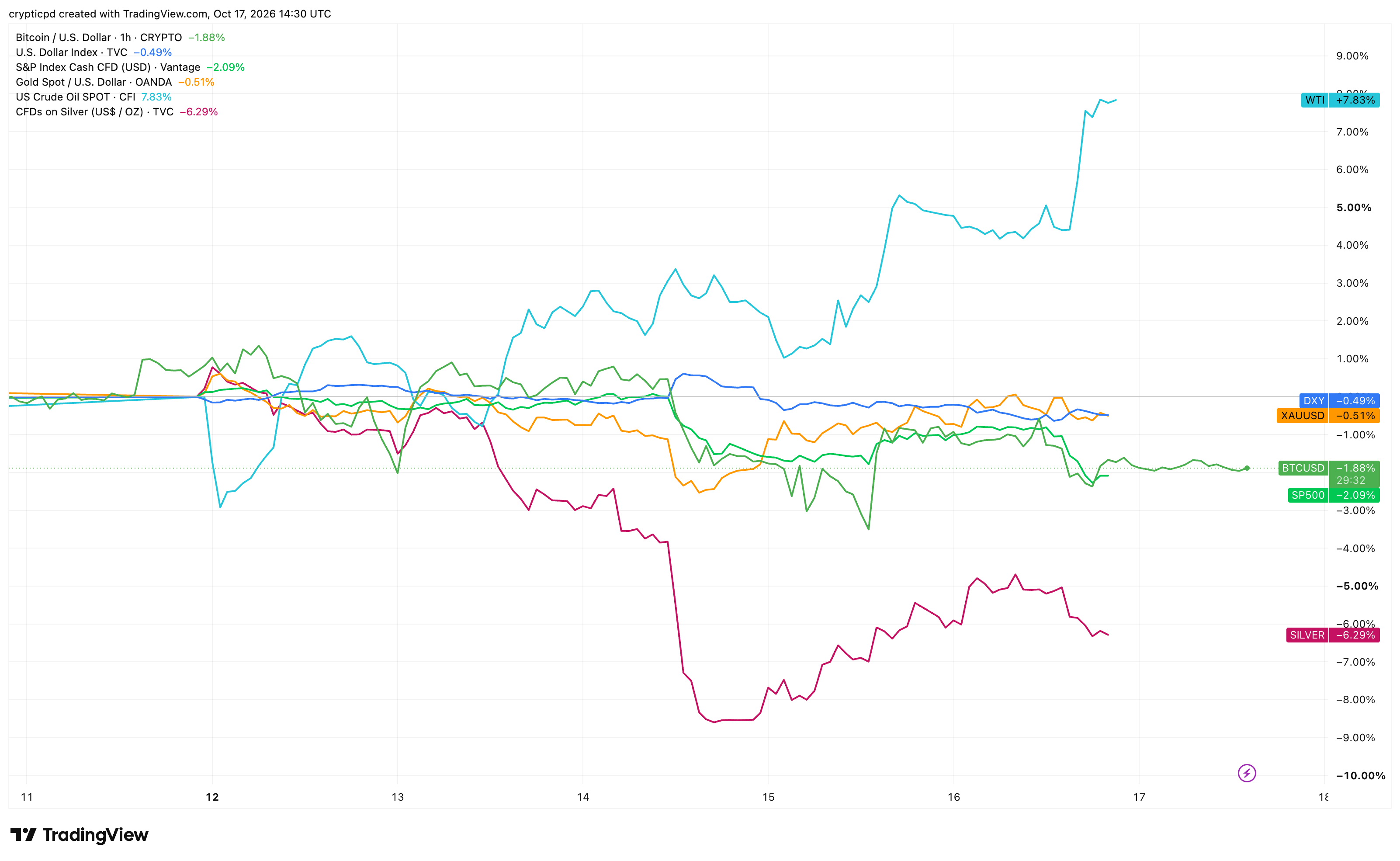
Wednesday’s US inflation report added to that discomfort. Consumer prices rose 0.6% in September, taking annual inflation to 3.7%, from 3.4% in August. Gasoline accounted for more than half the monthly increase, but the pressure extended beyond fuel: core inflation rose 0.3% over the month and accelerated to 2.6% annually.
That strengthened the case for further tightening without settling when the Fed would act. Policymakers also have weaker September payrolls and the tightening already delivered through borrowing costs to consider. The Conference Board highlighted that tension between what the inflation data suggest and the more cautious signals coming from Fed officials.
The market reaction changed as the week progressed. Yields and the dollar initially jumped after the inflation release. Later, anxiety about the debt financing the AI buildout drew investors towards government bonds, pulling yields back down while stocks remained under pressure. Renewed attacks around the Strait of Hormuz kept oil-supply concerns alive.
What We Covered This Week
At The Token Dispatch, we attempted to answer two connected questions: what makes a financial business difficult to replace, and who carries the risk when money finds new uses?
I explored the first in Money’s Utility as Moat, looking at how NG.CASH and Lemon build around local habits, licences and customer relationships. Stablecoins can provide shared infrastructure while the businesses offering useful ways to save, borrow and spend own the customer.
In Why Chip Lenders Now Sell Their Loans, I examined USD.AI’s shift towards originating GPU loans and selling them once they have a payment record. The model recycles capital, but still needs willing buyers and someone to bear the risk before the chips start earning.
Thejaswini explored Give the Bot a Loan, asking how AI agents might borrow to fund work before customers pay them. Her examination of Priors and other early projects comes back to familiar lending questions: is the income real, can the borrower repay, and who absorbs a default?
She also examined State of Hooks, on the contracts that customise how on-chain markets operate. Changing fees, sharing arbitrage profits and updating trading rules creates room for experimentation — and gives whoever controls those updates considerable power.
In Financial Nihilism, Vaidik connected the appetite for shorter, more speculative bets with fading faith in patient wealth-building and an increasingly uncertain future. His essay asks whether apparent recklessness also reflects a loss of confidence in the conventional route to financial security.
We have got more lined up for you in the coming weeks. Until then, we’ve got some recommendations that will keep you in good company.
On to this week’s reading list.
Regulation & Policy
Don’t Bet Against the Sports Bets: Matt Levine examines the fight over regulating Kalshi’s sports contracts and the absence of a market on whether those contracts will remain legal. (Paywall)
Crypto & Tech
Conditional Markets Are Beginning to Blossom: Galaxy maps the projects moving beyond predicting events to pricing their effects on assets and using markets to make binding decisions.
Active Liquidity On Chain: Evidence from PropAMMs Across Chains: Category Labs examines how proprietary market makers outperform passive liquidity pools through frequent repricing, counterparty-sensitive quotes and other trading advantages.
App-Controlled Sequencing, in a Box: Keone Hon introduces Typewriter, an open-source framework that lets crypto applications define their rules and control the order in which transactions run.
Paper Trade: Game Theory, Strategy, and Outlook: Shaunda Devens examines Papertrade, a synthetic perpetual-futures platform on HyperEVM offering highly leveraged trading in Bitcoin and Ether.
Making Options Easier to Use: Tacticalls previews an options-trading interface built around copying trades, following traders and hedging existing wallet positions.
The Big Business of Spare Capacity: Byron Gilliam connects the historical trade in New England ice with Grass’s attempt to turn spare internet bandwidth into a business serving AI’s demand for data.
How LLMs Might Make Crypto Mining Useful: Byron Gilliam explores Pearl’s proposal to combine blockchain security with AI computation, including why its mining work need not actually be useful.
Finance & Economy
Private Markets Are the New AI Markets: Matt Levine asks whether investors are increasingly paying private-market fees for exposure to an AI boom that already dominates the broader economy. (Paywall)
The Compute Credit Cycle Just Turned: Stanley Lee argues that lenders are beginning to distinguish between compute operators, making financing choices and customer diversification more consequential.
AI & Innovation
AI Companies Play Cat-and-Mouse With Secret-Stealing Spies: The Wall Street Journal reports on AI companies’ efforts to protect corporate secrets from espionage, including approaches to employees and insider threats. (Paywall)
Where AI Chip Architecture Meets Economics: Kevin Immanuel Gubbi explores the relationship between compute, memory and chip design, including why memory matters for running AI locally.
The State of Crypto Inference Providers: Blockworks Advisory surveys crypto inference businesses competing across price, latency, privacy and hardware, with differing dependence on token incentives.
Microsoft’s Bigger Bet on Its Own Silicon: Satya Nadella outlines plans to scale Microsoft’s Maia chips into the primary inference system for its own products and services.
How to Be More Ambitious: A Tutorial for Humans with Models: Felix Rieseberg offers a practical framework for using AI to pursue larger goals, investigate problems more deeply and draw on unfamiliar disciplines.
Anthropic’s AI Worm Research Raises New Fears About Smart Device Security: Scientific American examines research into AI spreading through connected gadgets, alongside cybersecurity experts’ assessment of how novel those threats really are.
Culture & Beyond
The Ladder of Knowledge: Alexander V Gheorghiu traces debates over mathematical truth and argues that Gödel’s incompleteness need not impose a final ceiling on human knowledge.
Deskilling the Body: Melanie Challenger examines how outsourcing navigation, memory and attention to technology can erode the abilities we develop by exercising them.
Plants Move to Get Away from Their Decaying Brethren: Scientific American reports on research into how plants move away from decaying material to protect themselves from its microbes.
That’s all for this week. I’ll be back next Saturday.
Until then, happy reading!
Prathik
P.S.: Read, watched or listened to something worth sharing? Send it my way for a future edition.
Token Dispatch is a daily crypto newsletter handpicked and crafted with love by human bots. If you want to reach out to 165,000+ subscriber community of the Token Dispatch, you can explore the partnership opportunities with us 🙌
📩 Fill out this form to submit your details and book a meeting with us directly.
Disclaimer: This newsletter contains analysis and opinions of the author. Content is for informational purposes only, not financial advice. Trading crypto involves substantial risk - your capital is at risk. Do your own research.
Thanks for reading! Subscribe for free to receive new posts and support my work.