


Hello,
Welcome to Edition 24 of The Reading List. Every Saturday, I share my favourite reads across crypto, finance, technology, culture, and beyond, alongside what I’m watching and reading.
The last few days have given us plenty to read, and even more to think about. From a consequential US election and one of Wall Street’s biggest sell-offs in years to the changing economics of AI and financial markets, there was hardly a dull moment.
Let’s get going…


StablesReward: Your AI Agent Spends, You Earn
AI agents can surf the web, read reviews, and book hotels for you. All these tasks cost money. But what if these tasks could earn you back something?
StablesReward does just that. Once you connect your agent to an MCP endpoint, it gives your agent a menu of paid tools. Every call your agent pays for earns you miles or stocks. And this is in addition to the rewards you earn anyway on your own spending across 800+ merchants.

Every purchase pays you back. The best part is that you can choose how you’d like to be rewarded. Transfer miles to airlines and hotels, or let your stocks build a portfolio from the spend you were making anyway.
Launching soon. Free to join.
The Week That Was
What a week it has been for the markets. Just when investors thought the US midterm elections would bring some respite, Wall Street delivered one of its sharpest sell-offs in years.
Let’s get the numbers out of the way first.
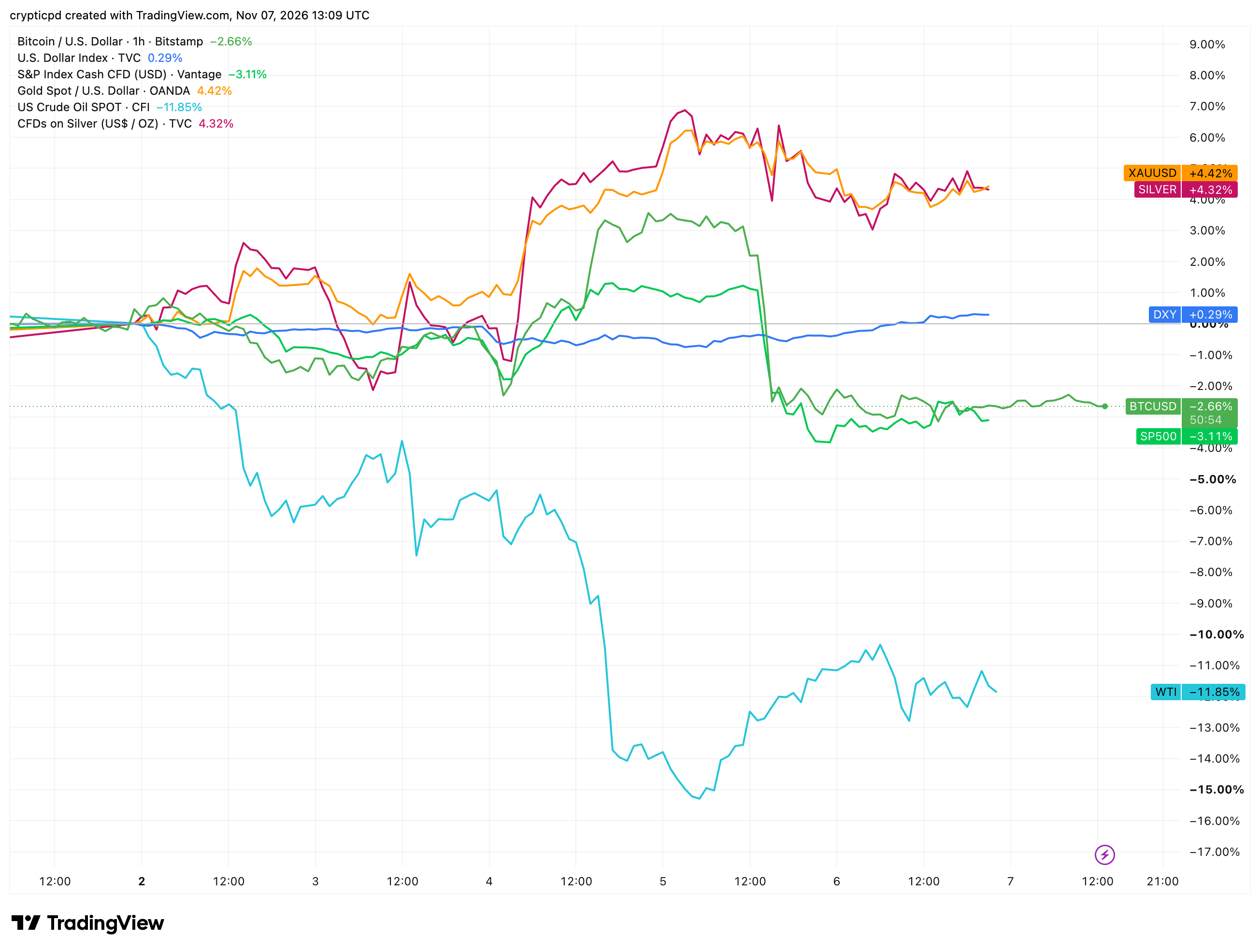
But these numbers don’t quite capture the drama that unfolded during the final two trading sessions.
On Thursday, November 5, the Nasdaq Composite plunged 5.5%, the S&P 500 lost 4.4%, and the Dow shed over 1,800 points. The Nasdaq-100 recorded its steepest single-day decline since the COVID crash in March 2020. Semiconductor stocks fared even worse, falling over 12% in a single session.
The sell-off wiped nearly $3 trillion off the market value of S&P 500 companies. A staggering amount of wealth evaporated in just one trading session.
What caused the panic?
For much of the year, the AI investment boom has powered Wall Street’s rally. Investors have poured money into everything from chipmakers to data centres, betting that the hundreds of billions of dollars being spent on AI infrastructure will eventually deliver equally impressive returns.
That confidence came under pressure following Tuesday’s US midterm elections, in which Democrats won control of both chambers of Congress.
Markets initially welcomed the election results with a rally on Wednesday. But the mood changed quickly as investors began reassessing what tighter oversight of AI infrastructure and restrictions on data centre development could mean for the industry’s growth.
The sell-off was particularly brutal for semiconductor companies. Nvidia lost over 9% on Thursday, while the broader Philadelphia Semiconductor Index suffered one of its worst days on record.
Friday offered some relief. The Nasdaq rebounded 1.1%, while the S&P 500 gained 0.3%. But both indices still ended the week in the red, losing 3.4% and 2.7%, respectively.
And then came another complication. The US economy added 165,000 jobs in October, considerably more than economists had expected. The stronger labour market raised the possibility that the Federal Reserve might have to keep monetary policy tighter for longer, even as markets were struggling with the sell-off.
Meanwhile, crude oil had a rather different week. Hopes that the prolonged US-Iran conflict could move towards a resolution sent prices sharply lower. WTI crude lost nearly 12% over the six days, reversing part of the war-driven surge that had dominated energy markets earlier this year.
Whether that’s evidence that Bitcoin remains a risk asset in the eyes of investors, or simply another week of crypto being crypto, I’ll leave you to interpret.
There was plenty more happening beyond the price charts. The economic case for AI infrastructure is facing greater scrutiny, Washington’s political landscape has changed, and the convergence of traditional finance and crypto continues to produce some fascinating developments.
At Token Dispatch, our team spent the week exploring some of these structural shifts.
What We Covered at Token Dispatch
This week, we explored how the infrastructure of finance is being reimagined, from biometric identity and tokenised securities to payments, banking, and exchanges. Across these stories, a recurring question emerged: as financial services move onto new rails, which parts of the old system remain valuable, and which become replaceable?
Vaidik explored one of the most consequential developments in market infrastructure in ICE is Building NYSE on Hyperliquid. The company behind the New York Stock Exchange is looking to use crypto-native infrastructure for perpetual markets. The piece argues that the real moat protecting traditional exchanges may not be their matching engines or settlement technology, but their regulatory licences, clearing relationships, and institutional trust. If that’s true, the exchange business could look very different in the coming decade.
Thejaswini took us from 19th-century Russian literature to the modern problem of proving that someone on the internet is actually human. In Proof of Palm, she explored how AI-generated identities and Sybil attacks are making human verification increasingly valuable. From CAPTCHAs and iris scans to palm-vein recognition, the piece examines the economics of proving personhood and the trade-off between security, privacy, and accessibility.
We also turned our attention to the banking system. In The Clearing House for Tokenised Deposits, we looked at efforts to connect tokenised commercial bank money with existing payment and settlement infrastructure. The broader question is whether banks can bring the benefits of programmable money on-chain without abandoning the regulated systems that already underpin financial transactions.
Two other pieces examined the economics of financial incumbents.
In Why Payments Still Sell, Thejaswini explored why investors continue to back cross-border payment companies even as stablecoins make transferring money cheaper. Using PhotonPay’s latest funding round as a starting point, she explained why the real value in payments increasingly lies in licences, customer relationships, local banking infrastructure, and the services built around moving money.
And in Banks’ Curious Case of Autocannibalism, we examined the uncomfortable position banks find themselves in as they adopt technologies that could undermine parts of their existing businesses.
These five stories point to a transition that is harder to ignore. Crypto is increasingly entering the financial system not merely as another asset class, but as infrastructure that could change how identity, money, payments, and markets work.
We have a lot more coming your way next week. Before we get there, here’s some literature that should keep you in good company over the weekend.
Some of these might be behind paywalls. Sorry!
Regulation & Policy
Democrat Victory Alters Landscape for Crypto, AI: Galaxy Research’s Alex Thorn examines how Democrats winning both chambers of Congress could stall crypto legislation and reshape the regulatory outlook for digital assets and AI.
Crypto & Tech
The Balance of Power — Stripe’s Payment Network Ambitions: Crossmint’s Alfonso argues that Stripe’s Link Balance for AI agents is part of a much larger ambition to challenge Visa and Mastercard’s dominance of global payment networks.
The AI Coin Nobody Understands: Blockworks examines Numerai’s NMR token, its AI-powered hedge fund approaching $1 billion in assets under management, and the significance of its token buybacks.
Finance & Economy
The Compute Certainty Tax: Ornn Research explains why GPU cloud providers sacrifice potentially lucrative spot-market revenue for discounted long-term contracts that make their infrastructure financeable.
Markets: A Jug of Ice Water: Noelle Acheson unpacks the week’s market sell-off, the vulnerability of the AI-driven equity rally, and the signals emerging from crypto markets.
Financial Predictionisation: Matt Levine explores how prediction markets could turn exposure to almost any financial outcome into a tradable contract, even when conventional financial products already exist.
How Much Should Anthropic Pop?: Matt Levine examines pre-IPO perpetual futures on platforms such as Hyperliquid and whether their prices can meaningfully predict the eventual public-market valuations of private AI companies.
AI & Innovation
What Will You Build For: Matthew Botvinick: The Cosmos Institute speaks with Matthew Botvinick about AI’s threats to democratic institutions, political surveillance, and its potential to enable participatory democracy at scale.
China’s Tech Swiss Army Knives: Kyle Chan explores how Chinese tech giants are expanding across AI, semiconductors, EVs, and robotics, becoming vertically integrated companies capable of competing across multiple industries.
Culture & Beyond
Boys to Men: Scott Galloway revisits America’s crisis of struggling young men, arguing that education reform, mentorship, and economic opportunity are essential to reversing their growing disaffection.
Ways of Seeing and Search for Home: An essay exploring how John Berger’s intellectual journey moved beyond art criticism towards questions of belonging, exile, human connection, and the meaning of home.
The Psychology of Separating Church and State: Two scholars explore how the psychological distinction between religious conviction and evidence-based belief helps explain the foundations of secular democracy.
That’s all for this week. I’ll be back next Saturday.
Until then, happy reading!
Prathik
P.S.: Read, watched or listened to something worth sharing? Send it my way for a future edition.
Token Dispatch is a daily crypto newsletter handpicked and crafted with love by human bots. If you want to reach out to 165,000+ subscriber community of the Token Dispatch, you can explore the partnership opportunities with us 🙌
📩 Fill out this form to submit your details and book a meeting with us directly.
Disclaimer: This newsletter contains analysis and opinions of the author. Content is for informational purposes only, not financial advice. Trading crypto involves substantial risk - your capital is at risk. Do your own research.
Thanks for reading! Subscribe for free to receive new posts and support my work.