


Hello,
Welcome to Edition 12 of The Reading List — your fortnightly antidote to the noise. Every two weeks, I share my favourite reads across crypto, finance, technology, culture, and beyond. I also share what I’m watching and reading.

Sticking with the flipped order from last edition, since it worked well.
What I’m Watching and Reading
I finally closed out Debt: The First 5,000 Years. The last 30% took me nearly twice as long as the first two-thirds did. Graeber slows right down into medieval and colonial credit systems that demand more patience than the opening chapters. I put the book down more often and sooner than I did in the first two-thirds.
One good thing is that the book stayed consistently informative right to the end. Since the book is split into thematic chapters, you could always pick it right back up from where you left off. Every chapter had something worth underlining, even the ones that might seem dull. Being useful and being interesting aren’t always the same thing, and Debt is a good reminder of that.
That wraps up my first tryst with a long book about money. I will pick up something lighter next. Got any recommendations? Write to me?
On screen, I’ve just started watching I Will Find You on Netflix. Two episodes in, and I’m liking how it’s unfolding. It’s got well-paced storytelling that builds tension just as well as Harlan Coben’s books do (Expecting some eye rolls from bibliophiles).
Adaptations can go either way, but this one feels like the right one after a long time. I will tell you more about it in the next edition.

The Fortnight That Was
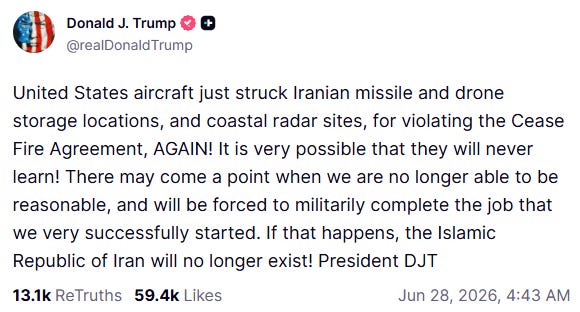
Two editions ago, I flagged how fragile the fresh Iran-US ceasefire looked, never more than one missile away from unravelling. Well, if a little over 24 hours of ceasefire counts, then the agreement surely worked. After renewed strikes over what the US called repeated ceasefire violations, President Donald Trump posted on Truth Social that “the Islamic Republic of Iran will no longer exist” if the violations continue.
On the market front, although the BTC price is still struggling around $60,000, we are not worried about its correlation with the broader crypto industry. There’s also little to support any theory around how every missile near the Strait of Hormuz will reroute crypto’s direction. That’s because there’s so much happening in parallel, including tokenised stocks, compute futures, bank-grade settlement rails, for one volatile ceasefire (or the lack of it) to decide where this industry goes next.
In the past two weeks, most of our stories have focused on how TradFi and DeFi are both pulling up a chair at the same table. The emerging world is creating new points where value accrues, and those who adapt to improve access to finance and the movement of money are positioning themselves well to capture a bite of that value.
What We Wrote Last Fortnight
Vaidik’s Who Actually Owns Your Stocks? and my follow-up, A Token Can Be the Asset, both examined how tokenisation inherits the old ownership chain and how different models of stock tokenisation offer varying benefits at different trade-offs.
Thejaswini’s Money Is Only as Good as the Issuer traced how banning a CBDC just hands the job of “trustworthy dollar” to stablecoin issuers instead, for better and worse. In Stretched to the Limits, I went back to evaluating the unravelling of Strategy’s STRC and what we got wrong in our first note about the credit instrument. I reassess the model and explain the problem in Strategy’s credit discipline. Thejaswini closed the week with Nobody Buys DeFi Insurance, on why protection markets stay tiny while the risk they’re meant to cover keeps growing.
I then wrote Who Captures Value in Web 2.5?, where I explored how value in the emerging world of finance is accruing in the translation layer connecting banks and institutions and who is capturing it.
Vaidik then wrote Compute Capital Markets, in which he explored how GPU hours are becoming a tradable commodity, with stablecoin settlement handling the plumbing work that electricity futures once did.
Collectively, these stories signal that the crypto industry is transforming into infrastructure and that it’s the best shot at building something that will outlast the next cycle.
There’s more lined up for you in the coming weeks, but here’s a reading list to keep you company until then.
Regulation & Policy
Reclaiming Opacity: The Imperative for Privacy in Crypto: A case for why crypto’s radical transparency became a surveillance tool, tracing the Tornado Cash and Samourai prosecutions and arguing that privacy needs to be infrastructure and not a feature.
Crypto & Tech
Money went on-chain first, the assets are following: Jevgenijs Kazanins uses a new Wharton paper to split RWAs into liquid money-like claims versus illiquid assets, and argues the second category is where tokenisation actually creates new liquidity, not just re-plumbs old.
Castle Labs RWA Report: This deep dive lays out the current state of real-world asset tokenisation, mapping issuers, curators, and distribution across the stack.
Rebuilding Securities Finance on Aave V4: Stani Kulechov makes the case that repo, margin lending, and securities-based loans are ripe for moving on-chain, with Aave V4 built to sit between the borrower and lender, and the fee-heavy stack of custodians and clearing houses.
Dollars Without Borders: Joel John argues that Web3’s biggest opportunities have shifted from memes and speculation to tokenisation and stablecoins, framing them as the mechanism by which American institutions and property rights are exported to the rest of the world.
Doppler: Rebuilding Capital Markets for the Tokenised Era: Doppler argues that tokenisation is just the starting point; the real opportunity lies in the liquidity, collateral, and financing infrastructure that enable tokenised assets to function as markets.
Going Institutional: A close look at ZKsync’s Prividium bet to win bank adoption against Canton Network, betting that cryptographic privacy beats governance-based trust once institutions cross borders.
State of Onchain Finance Q2 ‘26: Allium’s quarterly report tracks stablecoins, tokenised funds, equities, and prediction markets stacking up as onchain finance moves from speculation to infrastructure.
The other American Revolution: Fiat currency: Byron Gilliam traces fiat money to a 1690 Massachusetts Bay Colony experiment, arguing that tax-backed paper money was one of the decisions that helped secure America’s independence.
A system based on identity is vulnerable (behind paywall): Noelle Acheson’s Monday note on identity-based trust breaking down at scale, alongside her weekly stablecoin and macro calendar.
The moneyness of stablecoins (behind paywall): A new legal paper argues stablecoins aren’t quite money yet, and that the GENIUS Act helps less than most assume.
Finance & Economy
Small Themes: June 2026 (behind paywall): Citrini argues the AI trade has crowded out attention from five under-owned setups — senior housing, sold-out stadiums, exchange competition, fintech, and airlines.
Are Mega-Funds Taking Over Seed?: Data on how a16z, Sequoia, and General Catalyst have systematically taken over the top of the seed market, and why their conversion rates may not survive the current pace.
Two Concepts of Markets: A philosophical take on whether markets are a camera revealing prices or an engine that creates them, using prediction markets as the live test case.
The age of the solopreneur: Stripe’s economists find solo founders growing faster than employer businesses, with AI filling the gaps that once required hiring a team.
The World as Model: Meltem Demirors argues that the next trillion-dollar opportunity is the sensing layer that enables physical assets to be priced and traded the way HFT firms price markets.
AI & Innovation
America’s data-centre backlash puts the AI boom at risk: The Economist reports on rising community opposition to hyperscaler data centres across the US, with Meta sites worth $30 billion and gigawatts of load now colliding with local politics that could throttle the AI buildout.
How Much Memory Do We Fucking Need?: Zeitgeist Labs writes on the memory chip supply-demand mismatch that has taken Micron up nearly 10x in nine months, and how much room there might be left before the trade peaks.
AI’s winner-take-all era is over: Ashu Garg argues the “model is not the moat” narrative is winning as tokenmaxxing burns out, regulation shifts, and IPOs like Cerebras and SpaceX force a healthier debate about where AI value actually accrues.
How to survive AI mass replacement (& escape wage slavery): Dan Koe on how the real threat isn’t AI itself but dependence on employers and institutions whose incentives were never aligned with your survival to begin with.
AI search could make answers blander: New research suggests that AI search trained on AI-generated content could converge on the same narrow set of answers, a phenomenon dubbed “AI search collapse.”
Illegible benefits: A philosopher argues that every transformative technology, from anaesthesia to writing, has costs that are immediately visible and benefits that stay unimaginable until the technology creates the vocabulary to describe them.
The Winning Essays for the Big Questions About AI: Dwarkesh Patel’s contest winners cover ending pandemics with AI, what countries outside the AI race should do, and why labs may make money the way Hong Kong’s subway system does.
Culture & Beyond
Mary Beard Looks at Trump and Can’t Not Think of Ancient Rome: The classicist reads Trump’s triumphal arch, UFC-on-the-lawn, and $250-bill plans through the lens of Roman emperors, where spectacle, mind-changing, flattery, and coinage were the machinery of one-man rule.
Six Months into the “Hero’s Journey”: A former a16z partner reflects on leaving VC to found a biotech startup and why choosing which games to play matters more than winning any one of them.
29% Loaded: Jack Raines turns 29 with 29 beliefs about money, risk, envy, and adulthood — some reversed from his twenty-something self.
Counterfeit Congregation: An essay on how streaming, texting, and now AI companionship have replaced the in-person congregation humans evolved to need.
Europe IRL: Scott Galloway argues Sweden and the Netherlands show that capitalism and strong safety nets aren’t a contradiction, tying it to something the US is losing: trust.
America’s Next 250: An essay from General Matter’s CEO imagining the next 250 years of American energy and abundance, if the bottlenecks get solved.
A reading list for the deeply curious: a16z crypto’s team shares 13 summer reads on manufacturing, biology, market design, and management.
Want to recommend interesting literature? Write to me, and I shall include them in the next edition 👇🏾
That’s all for this fortnight. Catch you in the next edition.
Until then, happy reading!
Prathik
Token Dispatch is a daily crypto newsletter handpicked and crafted with love by human bots. If you want to reach out to 170,000+ subscriber community of the Token Dispatch, you can explore the partnership opportunities with us 🙌
📩 Fill out this form to submit your details and book a meeting with us directly.
Disclaimer: This newsletter contains analysis and opinions of the author. Content is for informational purposes only, not financial advice. Trading crypto involves substantial risk - your capital is at risk. Do your own research.