


Hello,
Welcome to Edition 17 of The Reading List — your fortnightly antidote to the noise. Every two weeks, I share my favourite reads across crypto, finance, technology, culture, and beyond. I also share what I’m watching and reading.


Altitude Card: Earn Cashback on What Runs Your Business
Most corporate cards lure you with rewards that are buried in a points portal. You rarely navigate through the portal because it’s riddled with friction, like points conversion ratios, redemption processes and expiry timelines.
Altitude cuts the clutter and rewards you directly in stablecoin. The cashback is credited to your account every month as USDC, needs no redemption and doesn’t expire.
The benefits of cards compound once you onboard your team. Issue unlimited cards for your team to spend anywhere in the world.

Every card is funded straight from the operating balance, so there’s no credit line to chase.
The best part? No back-end bank account needed. Altitude runs on stablecoin rails and supports teams in 150+ countries, with no need for a US-registered entity or a banking relationship.
Book a demo and put your business spend to work.
The Fortnight That Was
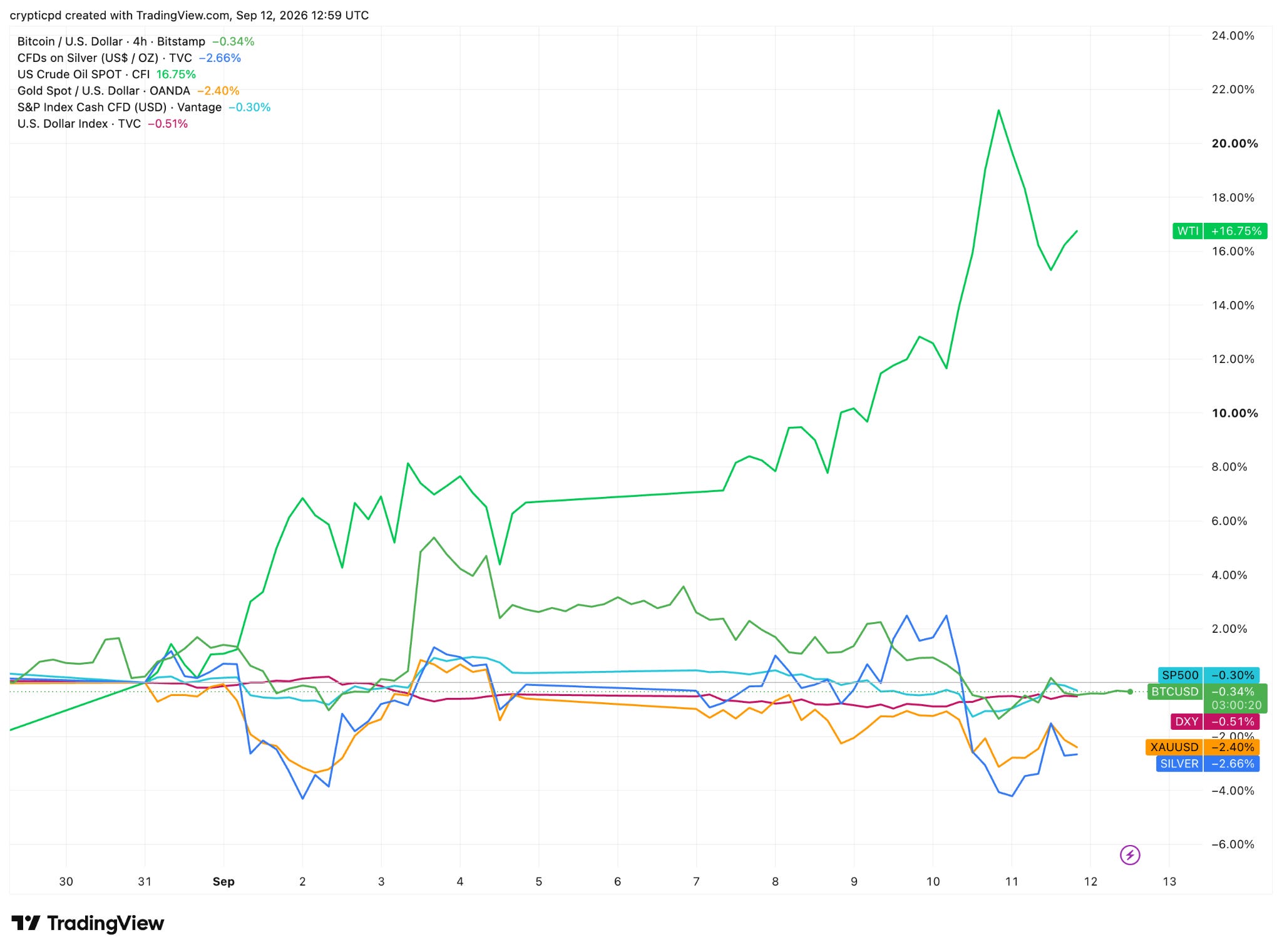
Over the last two weeks, oil (WTI) is up almost 17%. Everything else is flat or down: the S&P and bitcoin barely moved (−0.3%), the dollar softened (−0.5%), and gold and silver fell the hardest, down 2.4% and 2.7%.
The trigger was the Strait of Hormuz. US and Iranian forces traded strikes on oil tankers, Saudi Aramco’s Jizan refinery was hit for the second time in a month, and traffic through the chokepoint that carries a fifth of the world’s crude thinned to roughly ten ships a day. Brent pushed toward $97, US pump prices to $4.15 a gallon, diesel to a record.
An oil shock is an inflation shock, and an inflation shock changes what the Fed can do. Coming off a strong August jobs report, with 162,000 added against a 56,000 forecast, and unemployment steady at 4.1%, the market started pricing a rate hike. JPMorgan flipped from “no moves in 2026” to a 25bp increase at the September 15–16 meeting, and the odds of a hike crossed 60%.
That’s why the metals broke. Gold and silver had been the momentum trade all year; a hawkish repricing knocked the legs out, silver falling 6% in a single session. The tell of this fortnight is that the classic havens didn’t act like havens. Oil was the only asset honestly pricing the war. Bitcoin and equities just managed to hold.
What We Covered Last Fortnight
At The Token Dispatch, we spent the fortnight on covering structural issues. Two movements ran through the coverage: crypto reaching outward into the rest of finance, and a machine economy quietly wiring itself up alongside.
I opened with From Tokens to Everything Else, on protocols converting their fees into real-world assets, like stocks, dividends, tokenised equities, so that a protocol’s market is no longer measured only by the value of crypto. I stayed with structure in The Unbundled Fund, where near-zero custody costs let strategy, rebalancing and issuance come apart into separate, competing layers.
Vaidik then argued in From Bookie to Bloomberg that prediction markets are becoming risk infrastructure, ICE’s $2 billion move on Polymarket is about owning the data layer, much as Lloyd’s coffee house once did for insurance. I picked up credit in Troubleshooting On-chain Credit, making the case that on-chain lending only works once it stops pretending it can skip identity, reputation and legal recourse. Vaidik closed the finance thread with Crypto Options: Is the Time Now?, on why options are finally overtaking perps after October’s crash exposed how punishing path-dependent leverage can be.
Thejaswini took us into the machine economy. Software by the Sip looked at pay-per-call software markets built for AI agents that buy tools one API call at a time, while Who Checks the Agents? asked who verifies, pays and polices those agents, and found the trust layer lagging badly behind the payment rails.
Regulation & Policy
AI Could Make Markets Unintelligible: Byron Gilliam on economist Markus Brunnermeier’s pitch for a regulator-protected “human-only” trading lane, as insurance against markets where AI’s informational edge grows too wide for people to price.
Crypto & Tech
Robinhood Chain’s Reverse Playbook: 100y on how Robinhood Chain inverts the usual crypto playbook: start with tokenised stocks and proven DeFi rails, then bolt on stock-paired memecoins to pull in speculative liquidity.
Finance & Economy
Why Would Anyone Sell a Good Asset?: Oister on why secondaries are becoming central to India’s maturing private markets: selling a good asset isn’t a red flag, just two investors with different time horizons.
Interest Rates and Stock Prices: An Old Debate Resurfaces!: Aswath Damodaran dismantles the reflex that higher rates mean lower stocks; rates move discount rates and cash flows at once, so the net effect splits by company and sector.
An Ode to Counter-Positioning: Packy McCormick on counter-positioning: how startups win by adopting a model incumbents can’t copy without gutting their own revenue, and why that window shuts fast.
The Rise of Compute Markets: Jay Yu on whether GPU compute becomes a traded commodity like electricity, and why fragmented hardware, locations and pricing make clean benchmarks and derivatives so hard to build.
Hedging Compute Prices: Ronit Jain’s primer on cash-settled compute forwards and options, and how buyers, operators and lenders could finally put a price on future GPU cost.
Dallas Gets Some Equities: On the Texas Stock Exchange moving into equities and what a Dallas venue built to court issuers means for the NYSE/Nasdaq duopoly.
AAA AI: On how the AI data-centre buildout is quietly becoming a debt story, and the credit machinery — ratings, structured finance — assembling around it.
AI & Innovation
Software Is About to Eat the World Much Faster: Marc Andreessen argues coding agents move software production from the speed of human labour to the speed of compute, multiplying what a single engineer can ship.
The AI Transformation Loop: Mark Ajzenstadt on dropping AI into private-equity portfolio companies through short, measurable workflow experiments rather than year-long, consultant-led transformation programmes.
How AI Is Breaking the Internet Economy: Shoal Research on AI crawlers dismantling the web’s content-for-referral bargain, and the pay-per-request infrastructure publishers will need to charge machines directly.
My Prediction on AI in the Next Five Years: Ben Cera sees models becoming invisible commodities under outcome-priced apps, agents forming their own economy, and human edge shifting to trust, taste and distribution.
Will AI Soon Lead to Double-Digit Growth?: Ben Moll and Alex Imas, self-described AI bulls, explain why a capability explosion isn’t a GDP explosion; five heroic assumptions all have to hold, and probably won’t.
Investing in AI: Diego Lora maps the AI value chain across nine layers, with an uncomfortable takeaway for retail: most of the good exposure is private, foreign, or already richly priced.
The Existential-Risk Story Might Have Some Plot Holes: Byron Gilliam pokes at AI doom forecasts: earnest, internally coherent, and resting on precisely zero historical data points.
Culture & Beyond
How Do People Get New Ideas?: Isaac Asimov’s long-unpublished essay on creativity: new ideas come from connecting unrelated ones, which needs informal, low-pressure rooms where people can risk sounding foolish.
The “Learn to Code” Era Is Dead: John Burn-Murdoch reads falling computer-science enrolment as young people betting that “learn to code” no longer guarantees a career in an AI-shaped labour market.
The Group Chat Theory of Everything: Ben Roy on the group chat as the new private social unit quietly shaping what we buy, believe and vote for.
Doomscrolling Ourselves to Death: Ed West on James Marriott’s The New Dark Ages: the collapse of reading since its mid-century peak, and what a post-literate public does to democratic life.
The Forest Is Always Dark: Michael Dempsey on deciding under uncertainty: how much certainty you actually need before acting, and why a longer time horizon lets you ignore what short-term players obsess over.
It’s Not the Thought That Counts: Jords makes the case for wilful, selective ignorance: one finished local good deed beats endless paralysed awareness of problems you can’t touch.
One Big Web: A Few Ways the World Works: Morgan Housel on borrowing truths across disciplines: lessons from kittens, genetics and ecology that quietly govern business and behaviour.
The Curio Cabinet of Medieval Mental Health: Katherine Harvey on medieval medicine’s holistic view of the mind — gardens, music, company and animals as prescriptions that eerily anticipate today’s “social prescribing.”
Tolkien’s Secret to a Lasting Marriage: Tolkien’s 1941 letter to his son, framing marriage as sustained sacrifice rather than soulmate-hunting — a pointed rebuke to leave-if-unsatisfied culture.
Have We Finally Found Dark Matter? The LUX-ZEPLIN detector logged a collision that fits neither known backgrounds nor standard predictions: maybe a crack in a 40-year search, maybe noise.
That’s all for this fortnight. Catch you in the next edition.
Until then, happy reading!
Prathik
P.S.: Want to recommend interesting literature? Write to me, and I shall include them in the next edition 👇🏾
Token Dispatch is a daily crypto newsletter handpicked and crafted with love by human bots. If you want to reach out to 165,000+ subscriber community of the Token Dispatch, you can explore the partnership opportunities with us 🙌
📩 Fill out this form to submit your details and book a meeting with us directly.
Disclaimer: This newsletter contains analysis and opinions of the author. Content is for informational purposes only, not financial advice. Trading crypto involves substantial risk - your capital is at risk. Do your own research.
Thanks for reading! Subscribe for free to receive new posts and support my work.
Thanks for the feature!